"This button here turns on Pong, but you should be facing away from the door when you play." "This button here turns on Pong, but you should be facing away from the door when you play."
Not the best of days. Current was at the office. Felt like a dry run for the coming period of oddy-knocky solitude, and I did not acquit myself well. Probably because I'm still here, instead of forging new habits and routines with commendable resolve. I finished the morning work, took Birch to the creek, had leftover lunch, then got a car wash. There's one accomplishment. Since my car has been nagging me, I went to get the oil changed. This visit was less . . . military than previous trips. Valvoline no longer runs on barked orders and sir-yes-sir replies from the staff. A woman was the crew chief, and she had a down-home Minnesota-style attitude that was relaxed and charming. At the end she said well start 'er up -
And she did not start.
Hmm. i tried again. Clicketyclicketyclickety but no ignition.
"Did you break my car?" I said.
"No, it's - the battery might be run down. Let's give you a jump."
That's what it was. I guess I had my brights on for the time it took to check the filters and the oil. Seemed as if it ran down rather fast.
Okay, there's two accomplishments.
Went to the grocery store to get salad fixings and a few other things. There was a sale on my favorite hamburger seasoning. It's part of the McCormick brand refresh. They look better in the cabinet.

I thought: I will have all new spices in the HNP and they will be consistent and look nice and this will give me peace. So I bought it and put it in a box in the car dedicated to small things I pick up here and there for the HNP. Is that pathetic, or a good sign? I can't tell anymore. Then I went home and gave Birch a Milk Bone and took a nap. Odd thing about sleeping with Airpods playing white noise: when the alarm comes on, the white noise cuts out, a half-second - if that - before the alarm sounds. It's always the silence that wakes me. Never the alarm.
Have to fit that into a story or aphorism somehow.
Made dinner - homemade sauce, Caesar salad. Listened to Current tell me all about her grand day. Easy happy conversation, at least on her part. Afterwards I went to the Mall of America and sat on a bed I might buy, then I drove to the other end of the road and drove past the Fred in the dark to see it at night. I was wondering if they allowed decorative lights on the balconies. To my delight, they did.
It was the best moment of the day. I will have lights up there. It'll be nice.

Just when I think I have the office mostly cleaned out, I make another pass and I’ve four boxes. It’s as if the entire room is a cornucopia of books and ephemera and cultural detritus, endless regenerating through some inter dimensional portal.
Here’s something I found on the floor behind a shelf, stuck in a gap between the floor and the wall, almost lost for good:

And what is that? It’s an ancient affectation, from the days when I went by James r Lileks in the Minnesota Daily. It’s a piece of the sheets we used to print the paper. (Long story.) I clipped it out, or someone else did. It’s large enough to indicate it accompanied something special - a farewell piece? A big byline for an important story?
Then there’s this:

Apologies, dad. It must have fallen off something or been knocked off a shelf.
Grok:
The ribbon in the photo is the Asiatic-Pacific Campaign Medal ribbon (from World War Il), awarded to U.S. military personnel for service in the Asiatic-Pacific Theater between December 7, 1941, and March 2, 1946.
The ribbon's design matches closely: a broad golden yellow/gold center (symbolizing the region), with narrow stripes near each end in blue (Old Glory Blue), white, and scarlet/red (mirroring the American flag colors in a tripartite pattern on each side). The edges are yellow/gold, with the blue-white-red grouping inset slightly from the ends.
The three small bronze stars attached are campaign stars (also called service stars or battle stars). These denote participation in three specific designated campaigns during the Asiatic-Pacific Theater (e.g., things like Guadalcanal, Leyte, Luzon, or others-exact campaigns depend on the individual's service record, but three stars indicate eligibility for three qualifying phases or areas of operation).
That he was.
I know we all roll our eyes at the Clanker Video, and I probably share your horror or irritation.
Even the best stuff I see is so false, so obviously manifestly false. When I inflict my attempts on you, it's to enjoy the mistakes.
Not to say I was thinking of a Joe Ohio movie, but I was doing exactly that. Let us go from best to worst. Same prompt, different models.
Some models get the words right!
Some don't!
I forget which model this was, but man. Oy.
But wait until you see what's coming on Friday.

It’s 1977.
This is ROM, a computer magazine for the early hardcores.
So many bygone brands.
Wikipedia:
Southwest Technical Products Corporation, or SWTPC, was an American producer of electronic kits, and later complete computer systems. It was incorporated in 1967 in San Antonio, Texas, succeeding the Daniel E. Meyer Company. In 1990, SWTPC became Point Systems, before ceasing a few years later.
So many Texas companies! Makes me want to rewatch Halt and Catch Fire again.

And another:
Wikipedia:
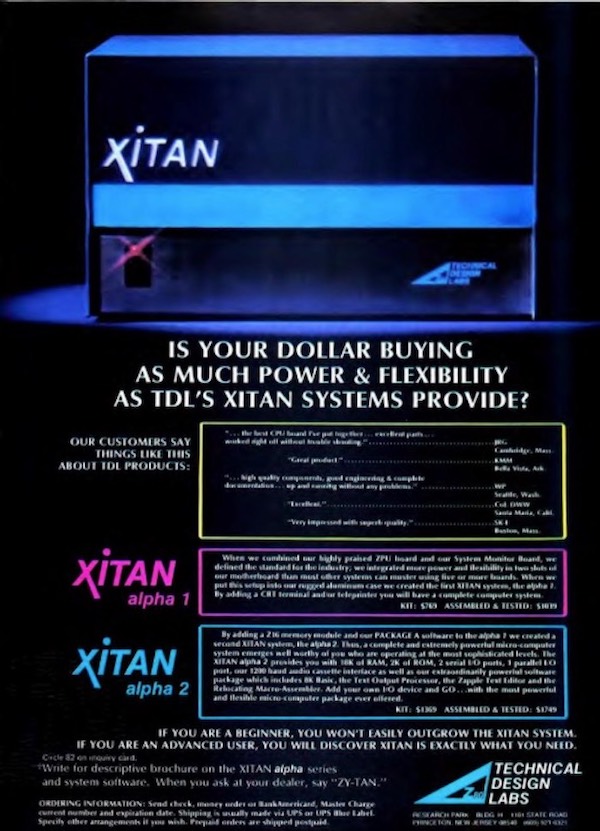
Technical Design Labs (TDL) was an early producer of personal computers founded in 1976 by Carl Galletti and Roger Amidon. TDL was based in Princeton, New Jersey, USA in the 1970s and early 1980s.
The company was later (1978) renamed Xitan, in honor of its primary product.
More on the Xitan, in the form of the brochure, here.
Ah. Such a great name for an early computer. The Altair. Look at this beaut.
It deserves a good history:
The Altair 8800 is a microcomputer introduced in 1974 by Micro Instrumentation and Telemetry Systems (MITS) based on the Intel 8080 CPU.[2] It was the first commercially successful personal computer.[3] Interest in the Altair 8800 grew quickly after it was featured on the cover of the January 1975 issue of Popular Electronics.
It was sold by mail order through advertisements in Popular Electronics, Radio-Electronics, and in other hobbyist magazines.
The Altair 8800 had no built-in screen or video output, so it would have to be connected to a serial terminal (such as a VT100-compatible terminal) to have any output. To connect it to a terminal, a serial interface card had to be installed. Alternatively, the Altair could be programmed using its front-panel switches.
A magnificent device.
Yes, it is 1977.
Laser-engraving! Meet the new dot, quite different than the old dot.
Nerd-wear! NERD WEAR!
The OCR typeface would be associated with the type on computer monitors, which wasn't correct.

I’m so glad we’re past the Flasher as a hardy-har thing.

Some pictures here.
I’ve no idea what it did. But it was better than the other computers, which just . . . blinked?
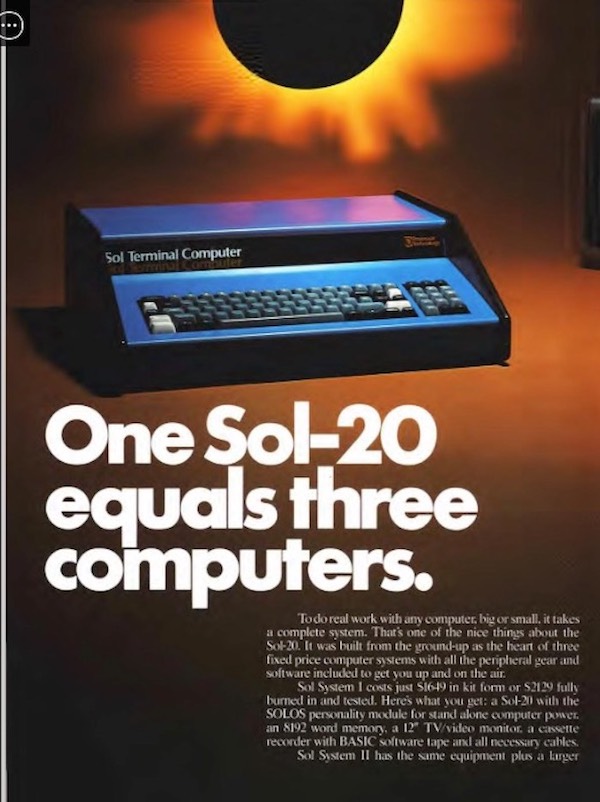
This was a big deal:
Info:
The Sol-20 was the first fully assembled microcomputer with a built-in keyboard and television output, what would later be known as a home computer.
Alas:
The Sol-20 remained in production until 1979, by which point about 12,000 machines[b] had been sold. By that time, the "1977 trinity" —the Apple II, Commodore PET and TRS-80— had begun to take over the market, and a series of failed new product introductions drove Processor Technology into bankruptcy.
But!
Felsenstein later developed the successful Osborne 1 computer, using much the same underlying design in a portable format.
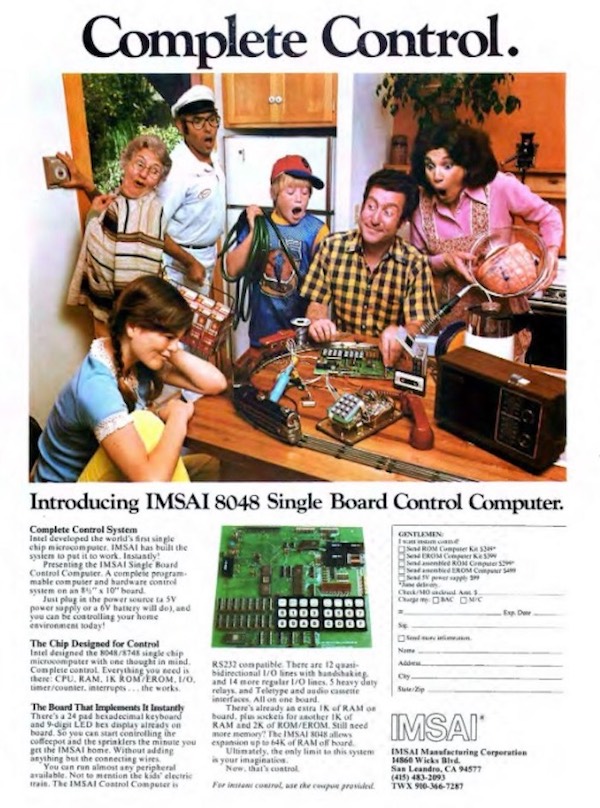
Wow: someone spent a dime on this one.
It’s a foretaste of ads to come. Everyone goggling at the amazing thing you did because you Know Computers.
That will do. 1948 Suds await, and more Joe around 11 AM. Thank you for your indulgence.

|