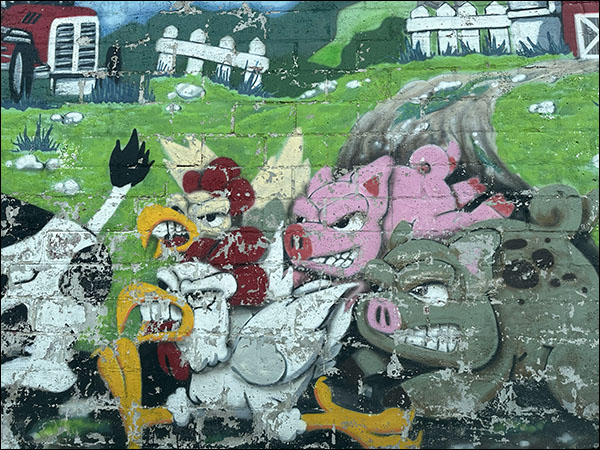
Had the Dentist appointment this morning, and was sure to brush and scrape and gargle so the hygienist didn’t get a blast of morning coffee and yesterday’s Indian food. It was a Father’s Day Vindaloo, a tradition. We ordered from a nearly place we hadn’t visited before, located in a failed ribs joint. That explains the peeling mural:
Sounds like a 90s band. Peeling Mural.
The interior of the restaurant is strange. I’m guessing there was an entrance sealed off on each end with double doors to provide a temperature buffer, so the winds of winter didn’t drop the inside temps by 10 degrees every time someone came in. One of the double doors has been removed, perhaps to open up space for people waiting to pick up orders. The door other is still in its frame, with hinges. It’s the damndest thing. A door with no purpose. Maybe if you go through it you're transported to another restaurant.
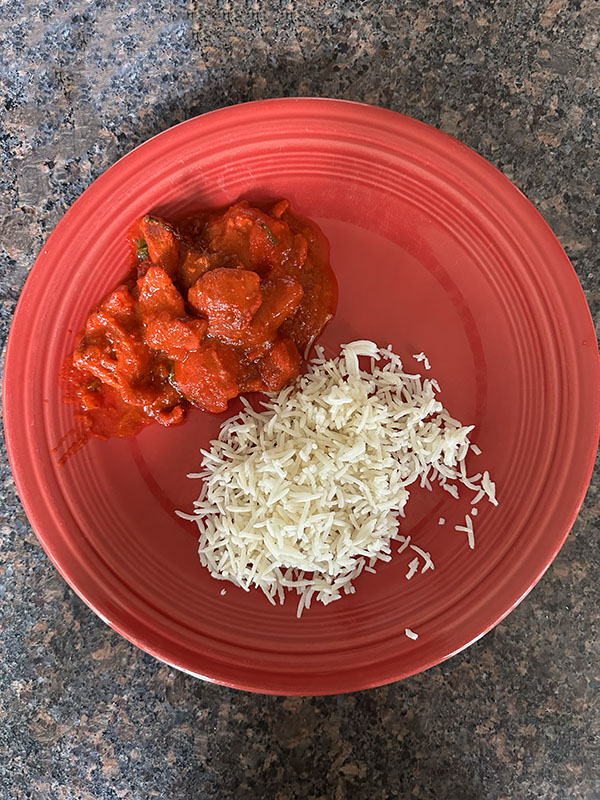
The food? Lurid:
And good. So very very spicy - and I ordered the medium of five options. The most extreme option would melt steel. When I finished I looked like I just stuck my head in the shower.
Rain, too. Much rain. Gloom, but not that cool dankness that seems to mock the summer. I like heat and humidity; it makes me feel alive in a way dry heat does not. Dry heat makes me feel as if I should have picked out an urn.
Went to the office, wrote. Over lunch - leftover vindaloo which I approached with both lust and regret - I sampled some old newspapers, as usual. I wanted to see what was happening today, June 18th, in 1908. Chicago.
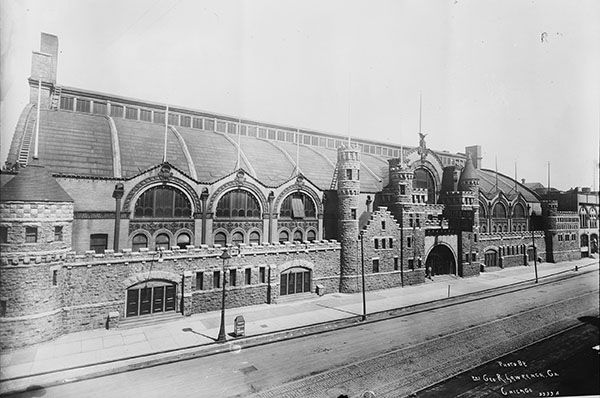
Republican National Convention. TR got a 47 minute standing ovation:
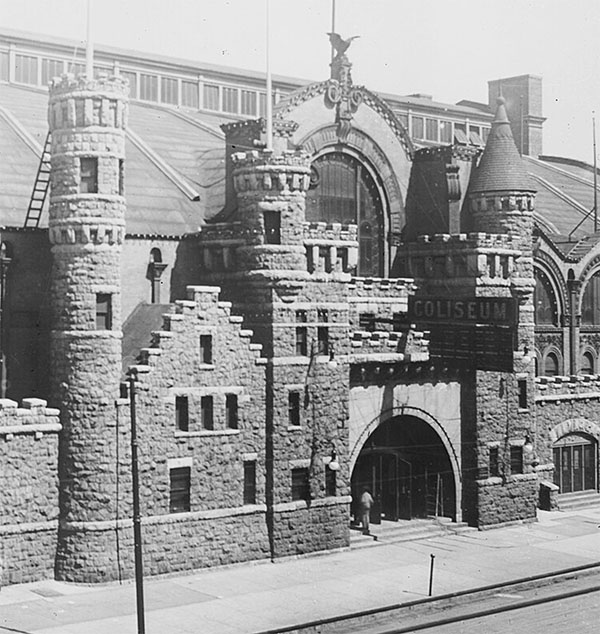
That would be the old Chicago Coliseum. The third.
 |
|
|
 |
|
Can you make it out? Not that hard. |
|
|
|
This part doesn't seem to match the rest, does it?
This might explain why:
Candy manufacturer Charles F. Gunther built the third Coliseum at 1513 South Wabash Avenue in 1899. He purchased Libby Prison, a structure in Richmond, Virginia, constructed as a warehouse which became a Confederate prison during the Civil War.
Gunther had it dismantled, shipped to Chicago on 132 railroad cars, and rebuilt in 1889 as the Libby Prison War Museum, which displayed memorabilia from the Civil War. After about a decade the old prison was torn down again, except for a castellated wall that became part of the new Chicago Coliseum.
Ah. That explains the disconnect between the entrance and the rest of the structure, perhaps. It’s an odd style, and pops up here and there - the Armory at the U of MN looks like that.
Side note: Gunther’s name, now forgotten, was known coast-to-coast for candy, the stories say. He did not invent caramels, but he popularized them. Good for him. We all like caramels.
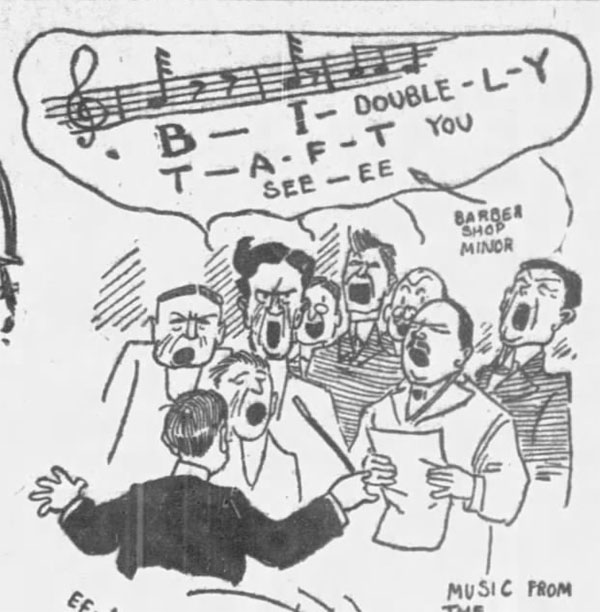
Anyway.The illustration above is from inside the paper. An account of the aftermath of the 47 minute hurrah. "The lid was off," a slang term for a great hurrah. The rest of the cartoon:
You never hear him refered to as "Billy." I do enjoy the cartoonist pointing out the sound of a particular note, and expecting that people would know what that meant.
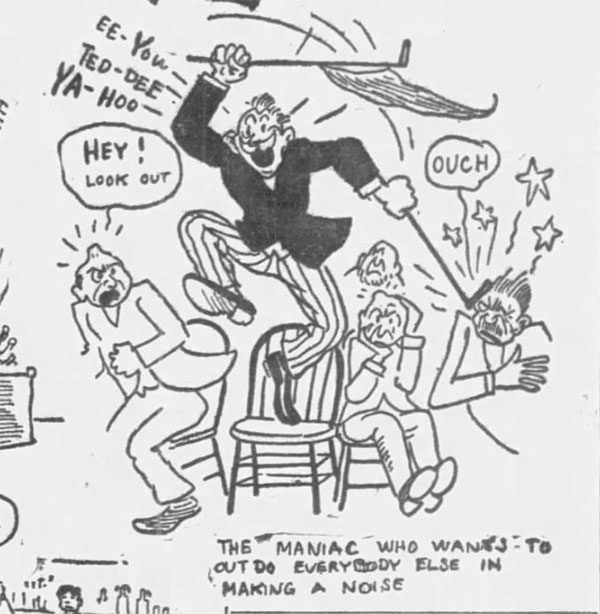
There's always one:
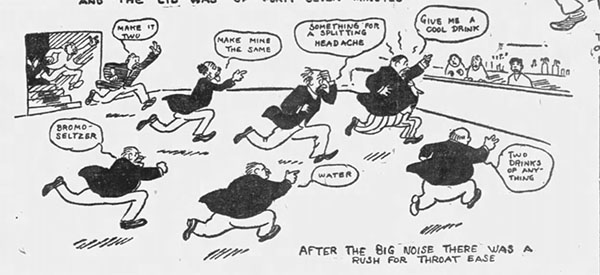
After the lid settled, a big rush for throat ease:
|
|
|
 |
|
I note this because I was delighted to see more work from old friend, whose work we enjoyed many years ago. At least it seems like it. |
|
|
|
Then it was back to work on something or other. Writing these last columns as if nothing is going to happen.
About ten more to go. Ten more rooms to paint in the house before it's razed.

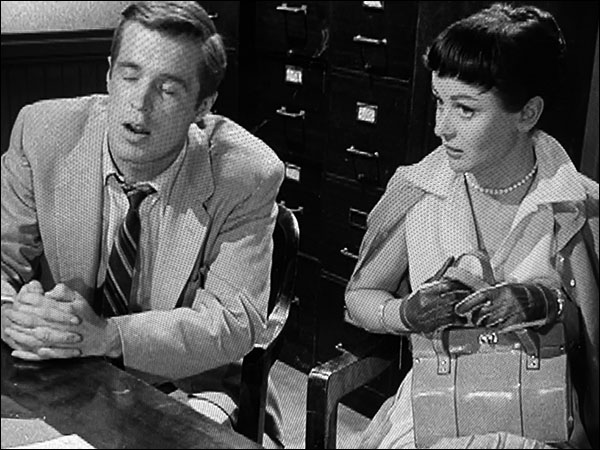
As mentioned, Peacock or Pluto or Paramount or whatever is taking away Alfred Hitchcock presents in a few weeks. Maddening. The pleasure of these old TV shows comes from seeing big names on the small screen, watching the trajectories of careers as they lift off or ease down. I don’t particularly care about George Peppard . . .
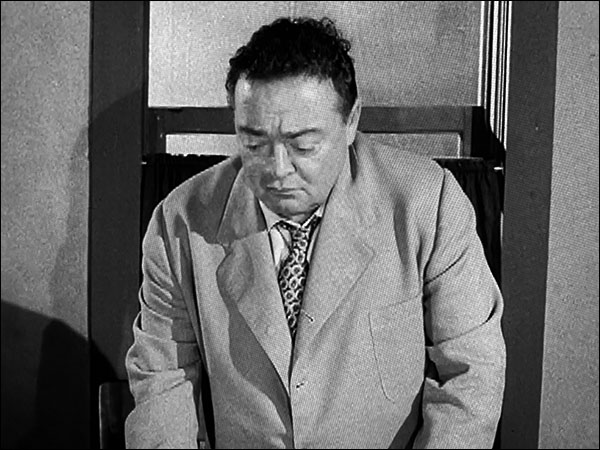
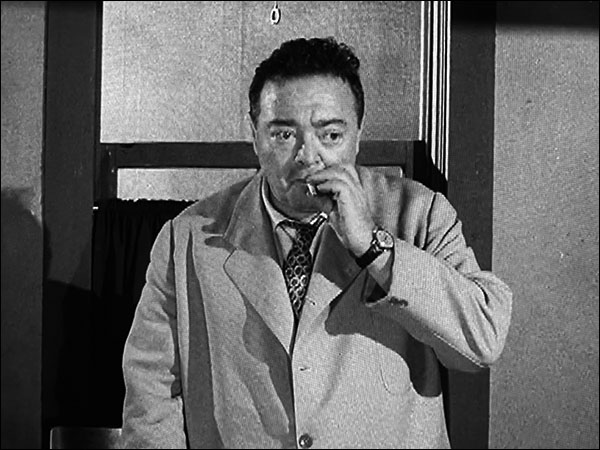
. . . but you have to smile when you see his foil.
The man could work the eyes. He ought to be a meme.
Another ep that caught my eye had to do with JDs. The dreaded juvenile delinquents, with their inexplicable violence and nihilistic disregard for the world. Knives and chains! Sometimes . . . guns! What was their problem? Why did the era that followed a great victory have such rotten youth? The literature of the time ascribed it to conditions and parenting, and I suppose that had a role. Insufficient policing, or indifferent policing - let them crack open each other’s skulls, we’re better off without them.
This one concerns a writer who comes to New York with the intention of getting into a gang and writing about it from the inside. He is . . .
He’s pretty good. He takes a room in a lousy neighborhood -
Yes, one of those crummy neighborhoods with dance studios and book stores. You hear “crummy” a lot in the ep, along with “lousy.” Also, enemies are “Finks.”
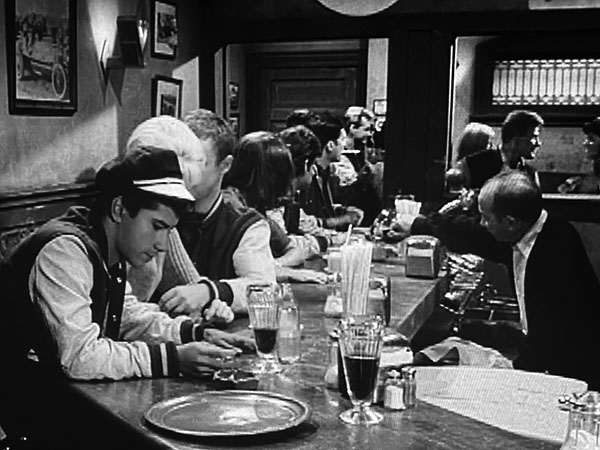
He goes straight to the soda fountain, where the hoods are gathered. There’s even an old man who runs the place and gets pushed around, just like West Side Story. It came out a few years after WSS, so it’s familiar terrain - and you’re thinking man, the 50s JDs are still around in ’64?
Oh - by the way, here’s the fearsome leader of the gang:
And he’s pretty good.
The director: Joseph Penney, who did many of the original Star Trek, including the famous “City on the Edge of Forever,” which was written by Harlan Ellison.
Who also wrote this episode of the Alfred Hitchcock Hour.
Oh, one more thing: one of the gang guys would go on to create the Showtime soft-core “Red Shoes Diary” series. Zalman King. Go figure.
One more thing: music by Lalo Schifrin. I tell you, it’s all there in these Hitchcock shows. It’s all there, the 60s culture. And beyond.
I’m not saying it’s great, I’m saying it’s interesting for what it is, how it looks and sounds, and what that tells us about the popular culture of the day. I’ll end with an imdb review:
I was 13 years old when I first saw this episode when it first aired in 1964. My family actually resided in Red Hook, Brooklyn at the time, and we laughed at the distorted depiction of the neighborhood as a crime ridden hell hole. It was in fact a very safe area, mostly Italian-American, with pockets of Irish and Norwegian Americans. There were no muggings, rapes, robberies or murders that I recall. There were gangs, but nothing like the homicidal Barons in the episode. If you didn't bother them, they didn't bother you. They basically just hung out, and were much younger than the actors in the Barons.
This is the pleasant neighborhood where "Moonstruck" took place. It became gentrified in the 1970's due to its low crime rate and is now in two sections known as Cobble Hill and Carroll Gardens. As for the episode, the acting is laughable and the plot so ridiculous it defies belief. No explanation was provided as to why the police allowed the Barons to terrorize the neighborhood or how these twenty somethings earned a living. Plot contrivances and silly dialogue abound. I am amazed no one yelled out "Hey, Daddy-o!"

|
|
 |
It’s 1949.
I’m guessing they’re carhops.
There’s nothing like it! Absolutely nothing! The completely different taste of Bud!
Well, it can’t be completely different, can it? I mean, it’s beer.
Hamburgers Deluxe, nothing like it! Live life! Every golden minute!

|
|
|
 |
|
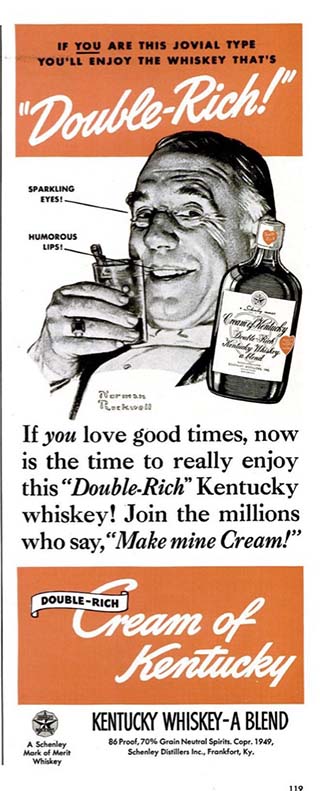
"Humorous lips."
"Cream of Kentucky" connotes something I don't want to think about when I think about whiskey. Specifically, cream.
It’s a Rockwell! Schenley had the money to pop for a Rockwell. |
|
|
|
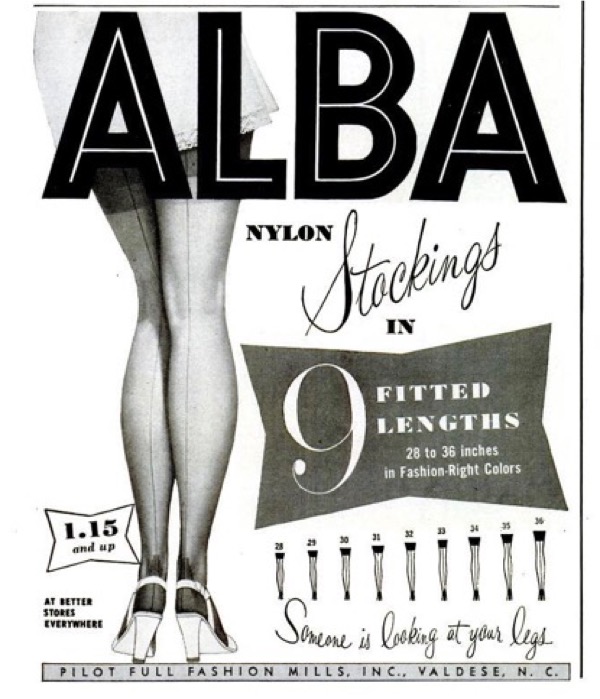
This is one of the most interesting taglines I’ve seen in an ad, simply because it’s so blunt.
Someone is looking at your legs.
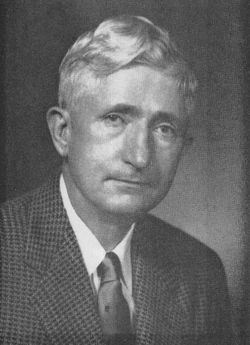
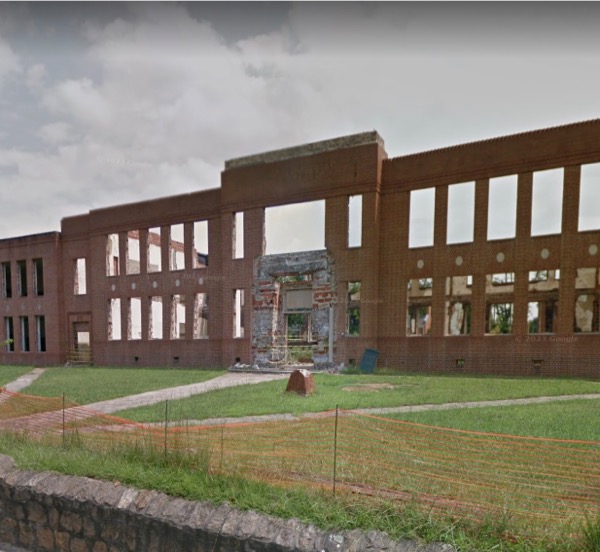
Big wheel in town? The high school is named after Francis Garrou.
Or rather, was.
They hacked something off the door frame:
And then it was gone.
Wait a minute - later views indicated they saved the door for a monument. Never seen that before.
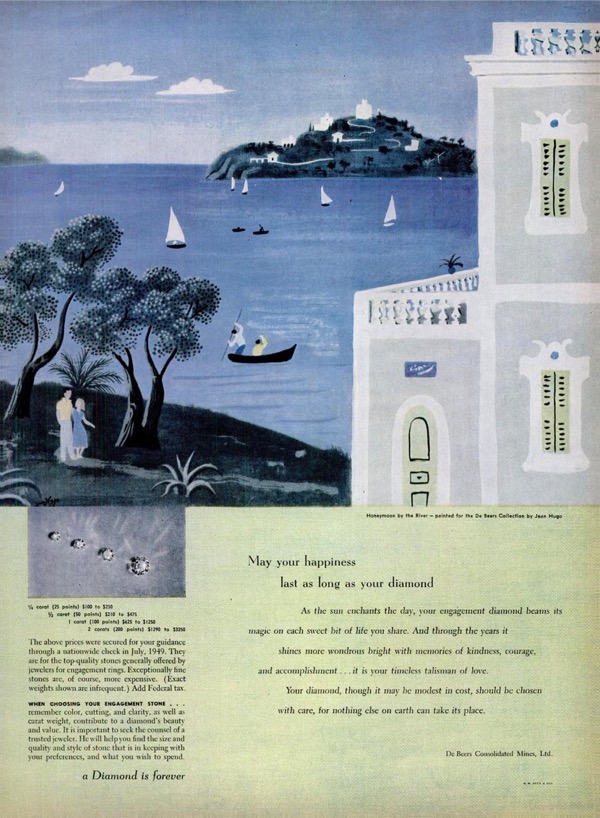
What’s this for? A very modern ad in its studied primitivism.
Text:
As the sun enchants the day, your engagement diamond beams its magic on each sweet bit of life you share. And through the years it shines more wondrous bright with memories of kindness, courage, and accomplishment ...it is your timeless talisman of love. Your diamond, though it may be modest in cost, should be chosen with care, for nothing else on earth can take its place.
Except another diamond.
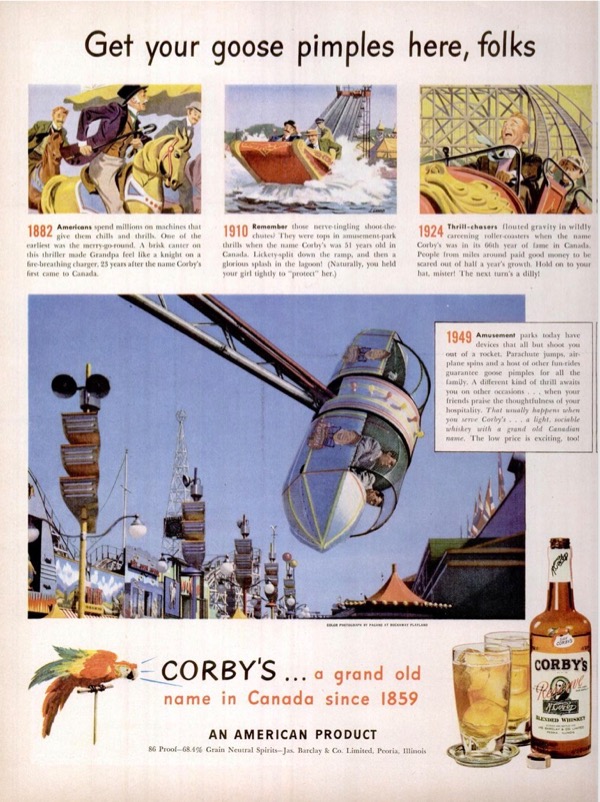
Remember those nerve-tingling shoot-the-chutes? No? You were probably drunk at the time
Maybe not the best whiskey promotion?
A name in Canada, made in America!
|
|
|
 |
|
None of that sissy rose-scented wife stuff for you, Bub! Look at the logo. It stirs a faint connection with some other stuff you use. That’s right! It’s Chap-stick, for your kisser.
“It brings healing comfort to rough fingertips, cracked knuckles, hardened, calloused hands. Buy 'Chap-ans' in the handy man-sized tube.
And say ‘thank goodness Chap-ans for a hand cream that does a man-sized job!’ |
|
|
|
|
|
|
 |
|
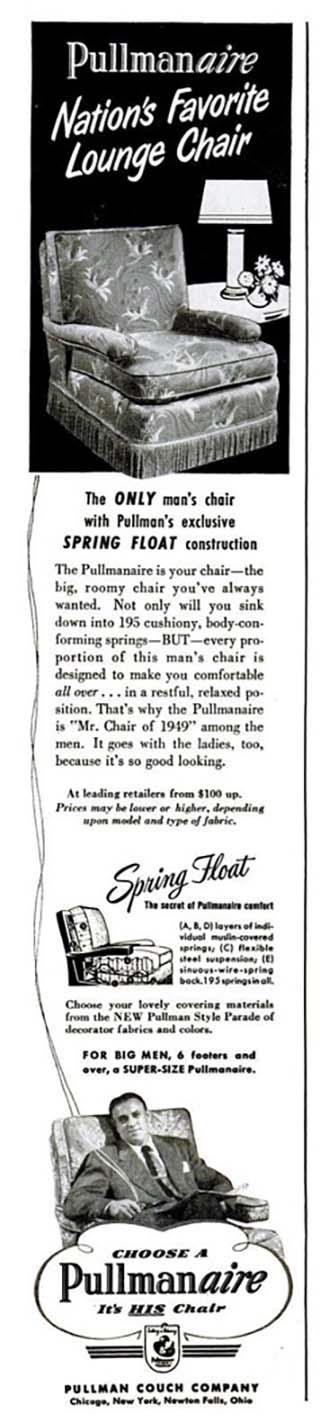
It’s the CHAIR OF 1949.
The ONLY man's chair with Pullman's exclusive SPRING FLOAT construction. The Pullmanaire is your chair--the big, roomy chair you've always wanted. Not only will you sink down into 195 cushiony, body conforming springs--BUT--every pro. portion of this man's chair is designed to make you comfortable all over . .. in a restful, relaxed position. That's why the Pullmanaire is "Mr. Chair of 1919" among the men. It goes with the ladies, too, because it's so good looking.
That’s right: a home chair based on a railway chair. It’s like selling someone an airplane seat. |
|
|
|
That'll do - see you around. DC Heroes concludes today, and this may be the last batch of entries EVER. I'm out.
REMINDER: Discourse piece on World's Fairs.

|