If you’re curious about whether you can recycle ceiling fans instead of having the Giant Twins cart them off for free, you can! Just drive to the county’s Difficult Waste Depot, hand over your license (of course you need an ID; otherwise people who aren’t taxpayers in the county would take advantage) and drive through when the door opens. You will be greeted promptly by the staff, who are among the nicest folks you’ll meet on a random day. I’ve mentioned this before; still true. The Hennepin County Waste Management workers are ridiculously cheerful. They make Chik-Fil-A staff look like Shake Shakers. (It has been my experience that Shake Shack counter people are morose, indifferent, and often rude. This opinion was formed at two airports, Washington DC, and Edina MN.) If you’re curious about whether you can recycle ceiling fans instead of having the Giant Twins cart them off for free, you can! Just drive to the county’s Difficult Waste Depot, hand over your license (of course you need an ID; otherwise people who aren’t taxpayers in the county would take advantage) and drive through when the door opens. You will be greeted promptly by the staff, who are among the nicest folks you’ll meet on a random day. I’ve mentioned this before; still true. The Hennepin County Waste Management workers are ridiculously cheerful. They make Chik-Fil-A staff look like Shake Shakers. (It has been my experience that Shake Shack counter people are morose, indifferent, and often rude. This opinion was formed at two airports, Washington DC, and Edina MN.)
“Whatcha got?” Said the lady in the bright yellow vest and bright red lipstick and oversized colorful glasses.
“Two ceiling fans,” I said, and if had been last month I would’ve said “And a partridge in a pear tree.”
“Oh, honey, I can’t take ‘em if they have the blades,” she said.
What?
“I know. Got to get the blades off. I told that to a man the other day and he went away and came back and they were all snapped off. I’m not saying that’s what you should do, now.”
“I hear Best Buy takes them.”
“Do they? If they do, and you see me again, tell me, ‘cause I like to pass that information along to folks.”
And then, my friends, the most extraordinary exchange occurred, and I just realized it’s column material. I apologize for short-shrifting here, and will probably make it free, since Friday is a paid day.
It will surprise you, on one level, and on another, it will be absolutely no shock wjhatsoever. Because it’s come to this.
It was five below this morning, but according to the weather app, it felt like six below. I’m not sure if the body is capable of “feeling” things in such small increments. After a certain point, cold is cold. As I write this, it has surged to minus 1, although it feels like 0, according to the app, because the wind is making it feel colder. Then it shouldn’t be 0, should it?
I came across a Substack by a formal coworker the other day, and I’m not going link to it because I don’t want to mischaracterize it. As far as I can tell he ’s a good guy, decent, good at his job, and a devoted family man. It was one of those pieces that attempts to explain any Minneapolis to outsiders, how there is a disconnect between the reality of the day, how one leads one’s life in a normal fashion, and the reality that is going on OUT THERE BECAUSE OF ALL THE KIDNAPPINGS AND ABDUCTIONS.
I can sympathize, to some extent.My neighborhood and the ones around it are untouched by trouble, for reasons, and most of my day is spent traveling through peaceful parts of the town. As it happens, this particular gentleman used to live close to the area where the riots occurred in 2020, and subsequently moved his family out to the farthest in suburbs. A reasonable reaction. It makes one less schooled in the realities of living in the city, perhaps, but if he works downtown, then he travels through it, and it’s able to make his own judgments - unless one takes the highway and moves friction-free past the neighborhoods that have faced challenges since 2020.
So. it was the usual piece about how people will talk about IT and how crazy IT is and then go back to talking about normal things. I don’t know if the conversations at the bus stop waiting for the kids are the careful feeling-out conversations, where you’re making vague generalities about what’s going on because you don’t know if the other person is going to absolutely lose their bleep. Some people will just bore in and demand to know where you stand, and this sort of personality is unreachable by argument, nuance, counter-suppositions, and so on. There’s no point: you either conform to this set of certainties, or you’re evil.
Most of the piece had to do with a trip to the Mall of America, a wonderful little family outing in the middle of the week. It sounded like a wonderful time, and he wrote it like a grateful father. Of course, their happiness contrasts with ICE rolling through the streets! Right. Well. At the dramatic point in the piece, the wife informed the husband that “there’s been another shooting.“ We are supposed to be thinking of the one that resulted in the death of the woman who was interfering with ICE, the phrase “another shooting” indicates that it’s on the same plane. The wife wanted to know if they should just go back to the distant suburb.
This is an ridiculous over-reaction. Shootings in North Minneapolis happen all the time. The Mall does not empty out because someone pops a rival. What’s more, the shooting was of a gang member by an LEO, and the gang members were probably of the sort involved in nefarious actions ranging from simple criminality to deplorable human trafficking. If the gang members had shot each other in a dispute over money or territory in sex trafficking, nobody at the Mall of America would have cared a bit, nobody would’ve known about it, and nobody would’ve thought that it plugged into some ever-escalating narrative about how bad things are getting.
If you live in that state of tremulous panic, everything is a crisis, and everything is a sign of the accelerating awfulness. You become accumstomed to it. You're rewired. When the crisis abates, you do not relax. You find another vessel into which to pour the same energy. Nothing is ever really happy again.

It’s 1925.
A paper aimed at a particular demographic:
 |
|
|
 |
|
The parallel world of segregation: there was an Associated Negro Press. |
|
|
|
Details:
The Associated Negro Press (ANP) was an American news service founded in 1919 in Chicago, Illinois by Claude Albert Barnett. The ANP had correspondents, writers, reporters in all major centers of the black population in the United States of America. It supplied news stories, opinions, columns, feature essays, book and movie reviews, critical and comprehensive coverage of events, personalities, and institutions relevant to black Americans. As the ANP grew into a global network. It supplied the vast majority of black newspapers with twice weekly packets.
A big audience:
It is stated in The Rise & Fall of the Negro Press by Gerald Horne that from 1865 to 1900 approximately 12,000 newspapers catering to African Americans were in existence.
As for Maury, the professor quoted above, let’s translate his French wiki bio.
He was a literary critic and editor at the Journal des Débats and wrote for the Gazette de Lausanne from 1909. In 1920, he was appointed correspondent of the Academy of Moral and Political Sciences.
In 1923 he married the American historian Charlotte Touzalin who translated some of his works into English.
And that’s all his bio says. His wife, who published a few books and was a notable intellectual of the day, has no wiki bio.
One of Muret’s books was “The Twilight of the White Races,” available here.
As for Englebert: the paper spelled his name incorrectly. It’s Preis. Or was. There’s not much about him on the web, other than some legal accounts of his deportation hearings. Not a big cog, in other words.

Hmm. All the info on the internet suggests that there was a Liberty Ship with that name, its keel laid in ’42, and that it was “the first major oceangoing ship and first of 17 Liberty ships that were named after African-Americans.”
|
|
|
 |
|
Hmm. All the info on the internet suggests that there was a Liberty Ship with that name, its keel laid in ’42, and that it was “the first major oceangoing ship and first of 17 Liberty ships that were named after African-Americans.” |
|
|
|
The Black Cross Navigation company was the successor to . . .
The Black Star Line (1919−1922) was a shipping line incorporated by Marcus Garvey, the organizer of the Universal Negro Improvement Association (UNIA), and other members of the UNIA. The shipping line was created to facilitate the transportation of goods and eventually African Americans throughout the African global economy. It derived its name from the White Star Line, a line whose success Garvey felt he could duplicate.[2] The Black Star Line became a key part of Garvey's contribution to the Back-to-Africa movement, but it was mostly unsuccessful, partly due to infiltration by FBI agents.
Well, about that:
In 1919, J. Edgar Hoover and the BOI charged Marcus Garvey and three other officers with mail fraud. The prosecution stated that the brochure of the Black Star Line contained a picture of a ship that the BSL did not own. The ship pictured was Orion, which in the brochure was renamed Phyllis Wheatley. The BSL was trying to buy the ship at the time, but did not own her yet.
The fact that the ship was not owned yet by the BSL constituted mail fraud. "In 1922, Garvey and three other Black Star Line officials were indicted by the US government for using the mails fraudulently to solicit stock for the recently defunct steamship line." On the witness stand, Garvey admitted that $600,000 ($10,922,000 in 2024) had been "blown to the wind”. The jury convicted only Garvey, but not the other three officers, and he was sentenced to five years in prison. In 1927, President Calvin Coolidge deported Garvey back to Jamaica.
I don’t know how he got another ship. But I found other stories about the launch with more info. The ship was the SS George W. Goethals, and would be repainted when it got to its destination.
Later in the year, from the Brooklyn Eagle:
It made one trip to the West Indies under auspices of the colored organization. But at the time Garvey was about to go to jail and his organization was in, bad financial straits, and the steamer was held at several ports in Cuba and the West Indies because of money due the crew and for repairs.
At year’s end it was sold, more or less, to a transatlantic freight company.
The ship’s full story:
USS General G. W. Goethals (ID-1443) was a German cargo liner that the United States seized during the First World War. She was launched in 1911 for the Hamburg America Line (HAPAG) as Grunewald. In 1917 the US seized her in Panama, and the Panama Canal Railway (PCR) operated her for the United States Shipping Board (USSB). In 1919 she spent six months in the United States Navy, in which she made three round trips to and from France to repatriate US troops. In 1920 the PRC bought her from the USSB. In 1925 the Black Star Line owned her. In 1926 the Munson Steamship Line bought her and renamed her Munorleans. She was scrapped in Scotland in 1937.
She was also instrumental in the rescue of the submariners in the S-5 incident.
Whew. That was a lot. Sorry.
Looks odd to modern eyes, but it was meant in a positive sense.

In a similar vein.
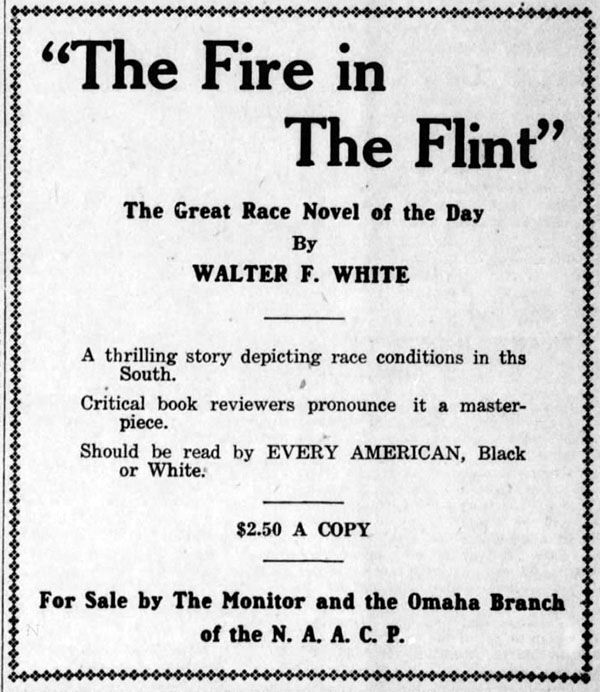
Details:
The Fire in the Flint is a 1924 novel by civil rights activist and writer Walter White, it was published by Knopf. The novel was written during the Harlem Renaissance and contains themes consistent with the New Negro Movement as well as promoting anti-racist themes and shedding light on racial oppression during the early 20th century. The novel tells the story of Dr. Kenneth Harper, an African American doctor and World War I veteran, who moves back to his hometown in Georgia to open a clinic and practice medicine after graduating from medical school. Dr. Harper, who is initially unwilling to be involved in racial tensions in the town, eventually fights against the Ku Klux Klan after he is subjected to hostile racism from the white residents.
Walter White was the head of the NAACP for 36 years.
Uh -
Of mixed race, with African and European ancestry on both sides, White appeared to be of European descent. He emphasized in his autobiography, A Man Called White : "I am a Negro. My skin is white, my eyes are blue, my hair is blond. The traits of my race are nowhere visible upon me." Of his 32 great-great-great-grandparents, only five were black, and the other 27 were white. All members of his immediate family had fair skin, and his mother, Madeline, was also blue-eyed and blonde.

As I said, hmmmm.

That'll do. Off to the waning hours of 1979!

|