Not sure they have enough meat on the grill. Six pieces, seven people. Maybe the gals will just have salad.
I suppose I haven't castigated the image above enough. Perhaps because its sins are manifest to all. If you don't see them I can't help you. I put it up as a pre-Fourth summer image from a truly imaginary world, a place where everyone prefers 7-Up. Not just 7-up, but 7-up in seven ounce bottles, which you can pound in two gulps. I do wonder about the woman in the background who's crocheted a strawberry-rimmed tambourine, though.
Well, I've nothing to report on an ordinary day. Productive, cool, rainy, hot, sunny - June running through the gamut. Ticking off the boxes as it heads for the exit. It's been a long June, a hot June, a good June. But I can't remember when it wasn't. June is when you're so accustomed to the full lush green glory that you cannot imagine it being otherwise. July is when you get bored with it. August is when you start to adjust your brain for the inevitable dimunition - still a long way off, of course. In September you have days that seem identical to June, but they're road signs that point in a different direction.
What matters most is the character of this day, and a simple good thing: the lawn is mowed, the grass is green, the water feature ploshes in the corner of the yard, the dog stretches out on the lawn and extends his limbs as far as they will go, because it is a good place and a good time, and only a fool can't see that. Or smell it.
Did you know that musicals' depiction of a time and place may not be accurate to the letter? That broad strokes may be painted, understood by the audience to represent a mood, a setting, a frame of mind? I think it's true!
Really, I do. In West Side Story, the corner store where Tony worked, the one owned by Ned Glass, is not indicative of the quantity of goods available in New York in the early 60s, but is meant to echo and amplify the poverty of the surroundings. Also, gang members did not dance in the streets in youthful exuberance whose precision gave a strange grace to their tribal violence.
Speaking of which: on a Minneapolis reddit thread the other day, the redditors were discussing the origins of crime, and how it came from social pressures. COVID, unemployment, that was making people just shoot one another in public over meaningless beefs. One poster said that the effect of social conditions on crime had been known for years, and cited the “Officer Krupke” number from West Side Story.
Except that the entire Krupke number concerns the gang members’ gleeful evisceration of every institutional explanation for their behavior. They are delighted and amused that the grups make these justifications; they know they act as they do because they can, and it is fun.
Anyway. Don't know how I got going on that tangent! Meant to talk about this: They revived "The Music Man" in Los Angeles. It is troubling. This review tells you what's wrong right out of the gate:
“‘The Music Man’ is a joyous love letter to the United States and a celebration of what we can achieve when we come together,” said Kate Horton, the executive producer. “We will ensure our team enjoy the right conditions for creating their most brilliant work and sharing it with the widest possible audience.”
You can see the problems, can’t you?
A love letter to the United States?
A joyous love letter?
“Widest possible audience.” You can’t have that if you want to send a joyous love letter.
As Broadway celebrates its return after a historic pandemic closure, offerings like this one beg the question: What exactly are we welcoming back?
Oh, I don't know; audiences? Paying customers?
To start, “The Music Man” is Professor Harold Hill, a traveling salesman who sells a small Iowa town on the urgent need for a marching band. He does this by, first, scaring parents with the looming threat that their children could be corrupted, and then pitching them a solution to prevent this exact fate.
WHY IT’S AN ANALOGY FOR . . . everything. I'm honestly surprised the writer didn't get in a dig at CRT critics.
“Essentially, Hill’s gimmick is selling small-town hicks on high culture and the idea of self-improvement: using their own American idealism as the very bait that turns them into his marks,” wrote Dan Venning in the Journal of American Drama and Theatre. He cited “The Music Man” as one of numerous musicals that centers on, and ultimately romanticizes, a scammer
Except Hill is redeemed, no? As wikipedia puts it:
Harold is no musician, however, and plans to skip town without giving any music lessons. Prim librarian and piano teacher Marian sees through him, but when Harold helps her younger brother overcome his lisp and social awkwardness, Marian begins to fall in love with him. He risks being caught to win her heart.
In other words, the character has an arc, because it is a musical and time is short and human nature and time must be compressed to tell a satisfying story. We stand outside the town and its people, but we’re also on their side, except we also get to vicariously enjoy the charismatic con-man’s work, because we like to root for a charming rogue. There is nothing particularly American about this. Every culture has a trickster.
It's also notable that self-improvement and high culture aspirations are manifestations of Amiercan idealism. That's . . . good, no?
Anyway. In the end of Music Man, there is a concert. Something is created, something comes from the collision of belief and fraud and tangled human intentions. But no no no, this is the takeaway: we romanticize the con man as a paen to the excesses of the American cult of “individuality,” as the article explains. How does it explain it? By quoting other people who say so.
You know that’s not enough, right? I mean, the transformation of the cultural left into crimped censorious blue noses that tut-tut when we make a musical about a charismatic con man, that’s not enough to hang an op-ed on.
And so:
“The show is frankly a happy valentine to yesterday, rich with music and laughter and the sentimentality of a less-complicated world,” wrote L.A. Times entertainment editor Cecil Smith, just before a production opened in Los Angeles in 1958.
“It was another, more peaceful time and place, this year of 1912 in the horse-and-buggy Middle West — an America easier to know and understand and love, for all its quaintness and ‘hick’ innocence,” echoed Los Angeles Times film critic Philip K. Scheuer of the 1962 movie.
And there are other quotes from previous revivals that say the same thing. Let us now put on our 2021 “They Live” glasses, for THE TRUTH:
The show’s rose-colored representation of Willson’s hometown is arguably expected, as “The Music Man” is rooted in his childhood memories. And these printed descriptions are likely accurate to those who wrote them; like the American theater, journalism is an industry historically dominated by white people.
She neglected to say white men. I wonder why.
Yet these sentences are full of coded language about the show’s sanitized and idealized setting, and its intrinsic value as a quintessential America. In reality, River City is probably as much a sampling of America as the Iowa caucuses are of presidential races: “The first-in-the-nation caucus state is whiter and more rural than the rest of the country; it doesn’t really represent America in some fundamental ways,” said NPR’s Sam Sanders. (The show’s nostalgia for a certain whiteness is in the text itself and can’t be easily solved with casting.)
The link goes to a production that cast a black man as Harold Hill. Apparently a good production, too.
So: theater must reflect reality. Also, black actors must be cast in any roles. Also, Iowa was racist in 1912. Also, the audiences of the aforementioned production were supposed to expect that a black Harold Hill would not cause any friction, and apparently everyone in the audience went along, because . . . hear me out . . . the actor who played Hill was really good, and no one cared about the alteration. Why would they? Hill is coded as an American archetype, so any American can play him.
The problem arises when this fantasy is mounted as an upbeat, tidy time capsule, allowing audiences to ogle a version of America that never existed.
Wait until the writer learns about “Seven Brides” and the foundational myths of Rome and the Sabine Women.
Ultimately, “The Music Man” sets forth a sanitized, insular and very white America — a vision regularly exploited by a recent president (who gained a following with scare tactics and sold a “think system” of his own) to stoke racial fears and pit Americans against one another. It asks audiences to cheer for yet another romanticized fraud.
In 1910, the population of the US was 91 million, and the white population was 81 million. So yes, it was very white. Iowa was, in fact, very very white. And dare I say insular, inasmuch as daily interchange with the coastal philosophers did not occur. But it seems that if you mention that Iowa was white in 1912, you’re endorsing the Trumpism of a hundred and ten years later?
Again, it’s a musical, with all the attendant fantasies, but you get the sense that there is something problematic in setting a story in 1912 Iowa, period, because 1912 Iowa is not 2021 California. And besides, we're not allowed to make pleasant myths about anything prior to January 2021.
“The Music Man” is selling tickets while the culture is calling for corrective lenses on such white-centered visions of American history and protesting in the streets for a new vision of modern American life.
I’m sure this makes some people nod with agreement - yes, yes, of course, that’s a great point. But rhetorically, it’s slop. A musical about an idealized setting of American culture set 110 years ago has the gall to sell tickets while people TODAY are CALLING for a corrective assessment of 1912 Iowa, and also protesting - in the streets, a sure sign of passion and truth - for “a new vision.” Of what? “Of modern American life.”
Because people are protesting today for a new vision, you should not sell tickets for a show from the past that depicts an anodyne vision of another past, because it does not align.
Not that every Broadway offering needs to address real-world issues, but
Ah, comrade, you should have phrased that better. That’s the sort of mealy equivocation that guarantees a ride on the third wave of the tumbrel parade.
but it’s concerning when productions not only turn away from society’s exposed ills but also inherently reinforce them for, as Horton said, “the widest possible audience.” In the words of Harold Hill himself, it’s “trouble with a capital T.”
Because we know that the average musical-theater goer shows up in an F-150 rolling coal with Confederate flags, looking for some reinforcement. Again, this idea:
It’s concerning when productions - all of them, all of them - turn away from exposed ills, and tell stories drawn from the culture’s archetypes.
People will enjoy them for the wrong reasons, and learn nothing, and leave the theater humming a tune instead of engaging in a deep, honest, self-critical discussion about the poisonous influence of the Myth of Iowa.
It’s 1905.
Enjoy the Fourth with a fresh layer of oblligatory fabric!
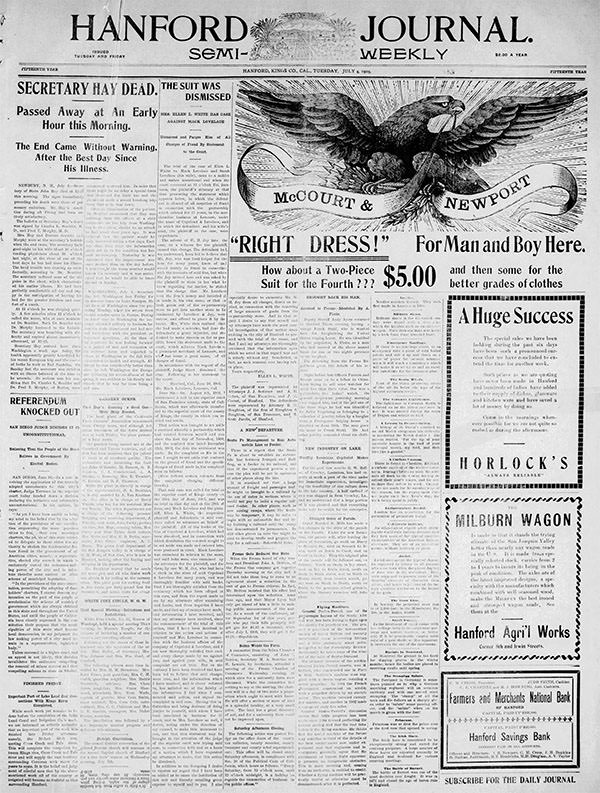
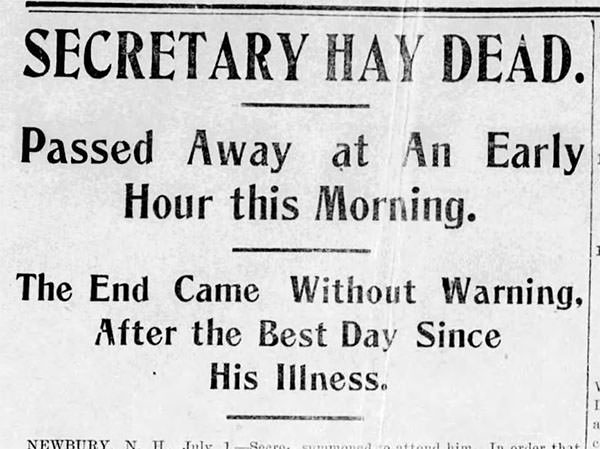
Top story:
I'm getting a strong sense of deja vu here. Anyway, here's a reminder of who John Hay was
Hay served for almost seven years as Secretary of State, under President McKinley, and after McKinley's assassination, under Theodore Roosevelt. Hay was responsible for negotiating the Open Door Policy, which kept China open to trade with all countries on an equal basis, with international powers. By negotiating the Hay–Pauncefote Treaty with the United Kingdom, the (ultimately unratified) Hay–Herrán Treaty with Colombia, and finally the Hay–Bunau-Varilla Treaty with the newly independent Republic of Panama, Hay also cleared the way for the building of the Panama Canal.
Regarded as a scintillating, patient, discrete, judicious, witty, and other kind words.

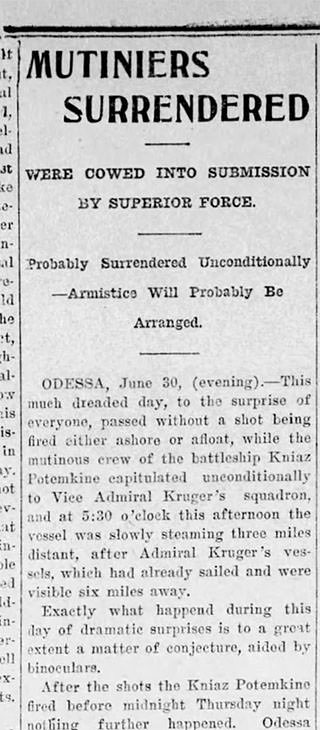
Here's a headline that doesn't exactly demand you read more. Obviously, it doesn't matter.

|
|
|
 |
|
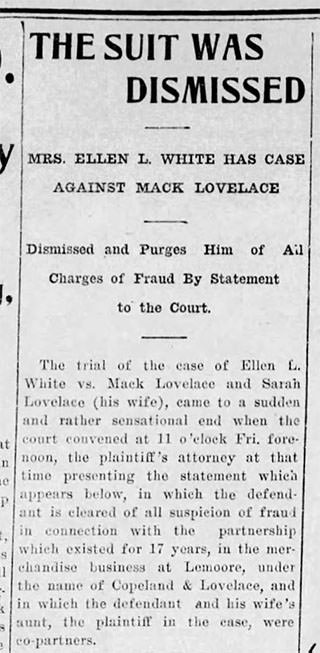
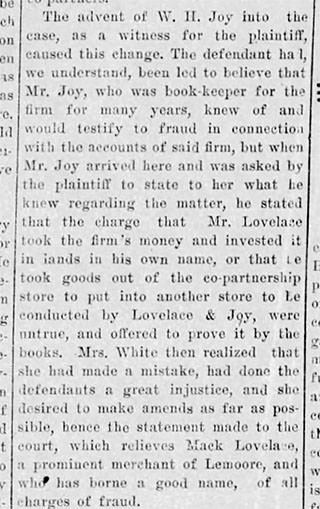
Okay, figure out this one. Aunts! Wives! My head hurts. |
|
|
|
 |
|
This clarifies matters. Somewhat.
She heard the testimony, and gave up the suit on the spot?
|
|
|
|
|
|
|
 |
|
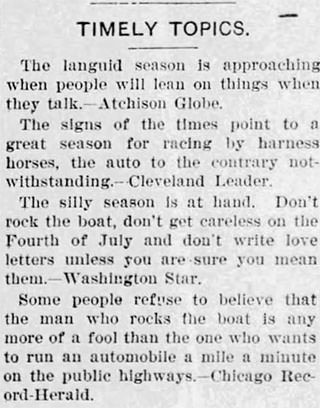
The editorials of the day. Interesting to see that the concept of the Summer Silly Season goes back this far.
Is it true, though? Some awful and significant things have happened in the silly season. First Iraq war started in the silly season, and Pres. Bush said something like "what is it about August," suggesting that the month was known for its bedevilment. |
|
|
|
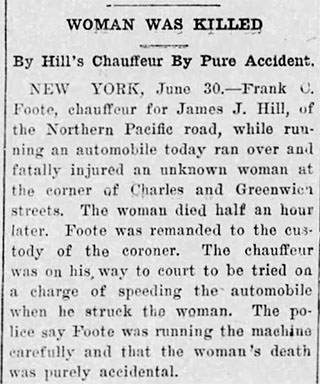
This is where I get strong deja vu. I know I've read this before. Gone to the location on google street view before.
|
|
|
 |
|
Makes the speeding case a bit harder to dismiss. |
|
|
|

That'll do. See you tomorrow. Update: Mid-Century washing machines galore.
|